
Do you really have to declare the money you make from forex trading, or can you quietly ignore it?
That question comes up constantly in Dhaka trading groups.
The answers usually come from whoever sounds most confident, not whoever actually knows the rules.
Most forex trading advice aimed at Bangladeshi traders stops at entries, exits, and leverage.
Taxes get a line or two, if that.
Then new questions appear—about withdrawal limits, fake brokers, and what a bank statement quietly reveals.
Part of the confusion is that rules shift.
Platforms operate differently, and much of what circulates online was written for traders in other countries entirely.
What actually helps are straight answers to the things traders keep asking: how to record profits, what proof you need, and what happens when a platform suddenly blocks your money.
A working tax FAQ for Bangladesh has to cover all of it—compliance and the operational realities around it.
Quick Answer: Forex trading profits in Bangladesh must be declared, as they can be subject to taxation under local laws regarding foreign income and capital gains. Traders should maintain detailed records of their transactions, including funding, closing trades, and withdrawals, to ensure compliance and accurate reporting. Consulting a qualified tax professional is essential for navigating the complexities of these regulations.
ফরেক্স ট্রেডিং কী, এবং ট্যাক্স প্রশ্নের পরিধি কোথায়
How do you report income when your broker statement, your bank deposit, and your withdrawal never quite line up?
That mismatch sits at the heart of most tax confusion, and it starts with what the activity actually is. ফরেক্স ট্রেডিং means buying and selling currency pairs to profit from exchange-rate movement — a global market that runs around the clock, five days a week.
For a trader in Dhaka or Chattogram, it usually happens through an offshore platform, in US dollars, with funds moving through a bank transfer or mobile banking.
That distance matters.
The trading itself is one thing; the paper trail it leaves behind is another.
Several activities may raise reporting questions.
Funding an account, closing a trade at a profit, withdrawing to a local wallet, or holding an open position across the year-end can each leave a different trace.
Whether any of those becomes taxable depends on how Bangladesh treats foreign income and capital gains — and that is where general guidance stops.
Broker location, account type, and transaction method shape the record you can actually produce.
An offshore platform may issue statements that never touch a local bank ledger, which makes reconciliation harder than it looks.
Confirm the specifics with a qualified professional before you act on any of this.
Why tax awareness matters before you trade
Tax awareness changes the decisions you make long before any return is filed.
Once you can name what a transaction has to prove — source of funds, date, amount, counterparty — you handle trades differently.
You save the confirmation email.
You stop treating a screenshot as proof of anything.
Picture a trader in Sylhet withdrawing profit across four separate transfers in one year.
Without a running log, those deposits arrive looking like unexplained credits, and untangling them months later costs real time and real money.
The records that answer a tax question usually answer a safety question too.
A withdrawal history with matching broker statements is precisely what you need when a platform stalls a payout or support goes quiet.
That same paper trail is how traders catch problems early, because a missing trail is itself a warning sign.
Beginners benefit because habits form early.
Active traders benefit because volume multiplies every gap, and small inconsistencies compound fast.
Keep your deposits, withdrawals, and fees organized in one spot, and make forex trading feel less like a paperwork mystery you tackle under pressure.
Good records will not tell you what you owe.
They will tell you — and any professional you consult — exactly what happened.
How to think about forex trading tax questions in Bangladesh
Records tell you what happened.
They do not tell you which part of it counts as taxable, and that is where the thinking has to start.
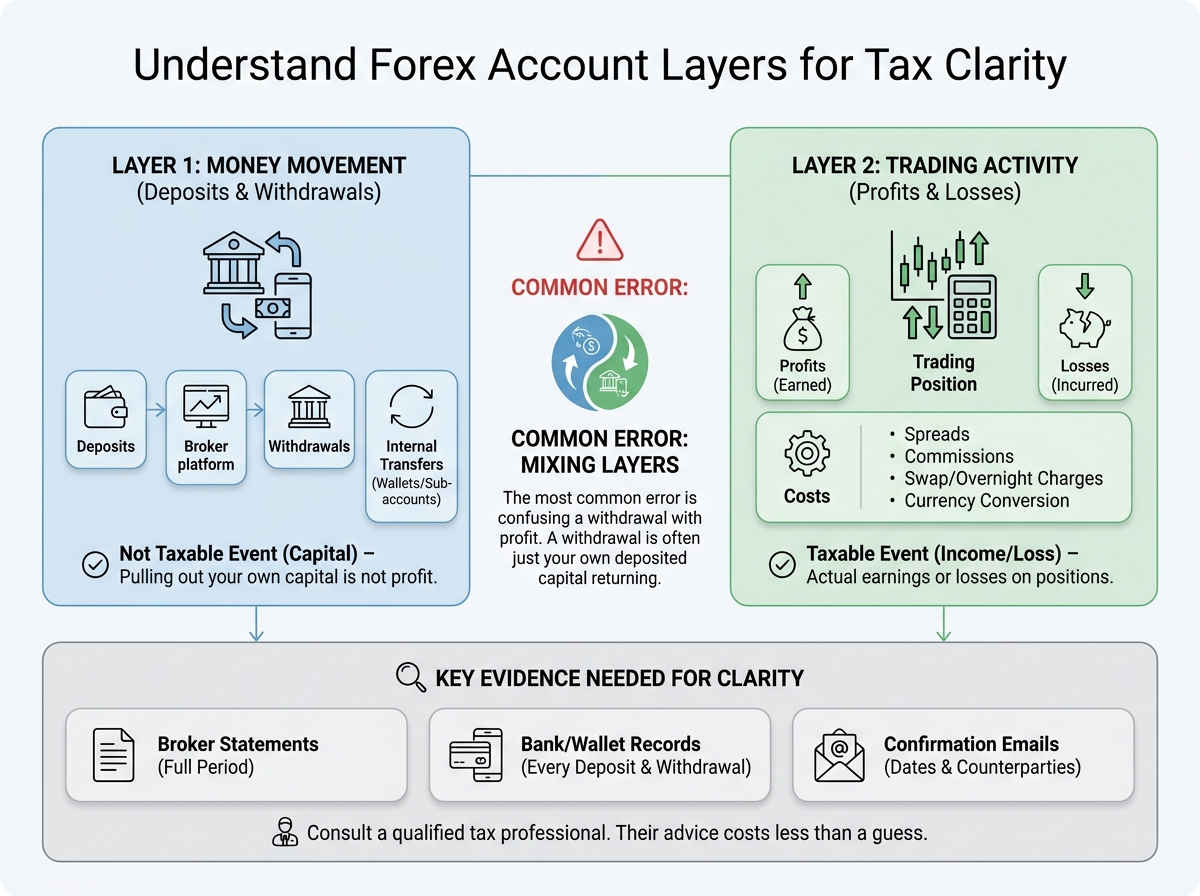
Think of your account in two layers.
The first layer is money movement: deposits you send in, withdrawals you take out, and internal transfers between wallets or sub-accounts.
The second layer is trading activity — what you actually earned or lost on positions.
Mixing those layers is the most common error, because a withdrawal is not profit.
You can pull out your own deposited capital and owe nothing on it.
The evidence you need to separate the layers is specific.
Broker statements covering the full period, bank or mobile-wallet records for every deposit and withdrawal, and the confirmation emails that tie a transfer to a date and counterparty.
If a platform only shows a balance, export the transaction history while you still have access to it.
Then account for the costs that quietly reduce a result: spreads, commissions, swap or overnight charges, and currency conversion between taka and the account’s base currency.
Losses belong in the same record.
How any of this is classified or reported in Bangladesh depends on facts only a qualified tax professional can weigh.
Take your records to one before you file.
For anyone active in ফরেক্স ট্রেডিং, that conversation costs far less than a guess.
Forex tax FAQ for common beginner and active-trader questions
The questions beginners ask first are rarely the ones that matter most. “Is forex income automatically taxable in Bangladesh?” depends on facts: how the activity is structured, where the money moves, and how you document it.
One trade proves little; consistent, evidenced activity is a different story.
Deposits and withdrawals cause most of the confusion.
Money you send to a broker is a transfer, not profit, and money you pull back is capital movement until it’s reconciled against your starting balance.
Profit or loss comes from the difference between what you put in and what you take out, adjusted for open positions, fees, and the exchange rate on each date.
A trade can be profitable in dollars but still leave you with a smaller taka figure after conversion.
So what should you keep? Statements, deposit confirmations, withdrawal records, fee notices, and a running log of dates and amounts.
They turn an abstract question into a documented one, and they protect you if a broker later refuses a withdrawal or quietly rewrites its terms—a pattern our team has written about before for anyone weighing broker safety in ফরেক্স ট্রেডিং.
Sorting activity, evidence, and open questions
| Question | Evidence to collect | Risk or uncertainty | Who to consult |
|---|---|---|---|
| Trading profit and loss | Broker statements: opening balance, closing balance, realised results | Recognition timing may differ from the calendar year | A qualified tax professional |
| Deposits and withdrawals | Bank/mobile-wallet records matched to broker entries | Transfers can be misread as income | A qualified tax professional |
| Broker fees and statements | Fee schedules, swap, commission notes | Fees may or may not reduce the taxable figure | A qualified tax professional |
| Offshore broker arrangements | Platform terms, licensing details, withdrawal history | Foreign-exchange rules and reporting duties may apply | A tax professional and your bank |
| Managed or copy-trading activity | Service agreement, fee structure, who controls trades | Analysis may shift if you’re not the decision-maker | A qualified tax professional |
| Blocked withdrawal or suspected scam | Chat logs, payment receipts, complaint references | Recovery is uncertain; losses may be treated differently | A lawyer and the relevant regulator |
Notice three of the six rows end with the same destination—that reflects how Bangladesh-specific treatment depends on current rules and individual circumstances.
The remaining value sits in your own file: if there’s a managed, signal, or copy-trading arrangement, start by identifying who made the trading decision, and collect the agreement before collecting opinions.
Practical record-keeping and decision guidance
Using one spreadsheet is way better than digging through a folder of scattered screenshots.
Open one tab per month and give it five columns: date, type, amount, currency, and where the money actually moved.
Every entry needs a matching document.
Save broker statements, bank deposit slips, mobile-wallet or payment-gateway confirmations, and platform trade-history exports.
Download them monthly rather than waiting for year-end, because platforms sometimes retire older reports.
Missing statements are common with offshore brokers.
Ask support for a formal account statement in writing, and keep the email thread if they stall.
When a deposit and a withdrawal disagree on currency, record both figures plus the conversion date instead of forcing one tidy number.
Disputed transactions deserve their own note: what you expected, what arrived, and when you raised it.
If a platform blocks a withdrawal twice, stop adding funds and take the paperwork to a professional before depositing again.
Broker questions worth asking early: who holds client money, how withdrawals are processed, and what documents the platform provides on request.
Those answers shape your ফরেক্স ট্রেডিং records long before they shape any return.
A clean monthly habit turns tax questions into lookups rather than reconstructions.
Common misconceptions and safety limits
A broker who says your profits are tax-free is not a tax authority.
An influencer saying the same thing is not one either.
Treat both as marketing until someone with credentials has seen your documents.
A ট্যাক্স FAQ like this one explains how to think about records and reporting.
It cannot certify that a platform is licensed, solvent, or honest.
Those are separate questions, answered with separate evidence.
The warning signs tend to cluster in a recognizable pattern: guaranteed profit language, deadlines that push you to deposit today, bonuses tied to trading volume, and withdrawal requests that stall behind fresh verification steps.
None of those prove fraud alone.
Together they describe a business model that earns whether you do.
Withdrawal friction deserves attention because it is the moment a platform’s incentives become visible.
If the terms change only when you try to leave, that tells you about the broker, not about the market.
What this article cannot determine matters just as much.
It cannot say whether your gains are taxable, whether an offshore account is legal for you, or whether a particular platform is safe.
Those answers depend on your documents and on how Bangladesh’s rules apply to your facts.
New questions will keep arriving as your activity grows.
Anyone active in ফরেক্স ট্রেডিং should read a “no tax” promise as an invitation to verify, not a conclusion to rely on.
ফরেক্স ট্রেডিং কিভাবে শিখব?
ফরেক্স ট্রেডিং শেখার জন্য প্রথমে মৌলিক ধারণা, সঠিক প্ল্যাটফর্ম এবং মার্কেটের গতিবিধি সম্পর্কে জানতে হবে। অনলাইন কোর্স, ট্রেডিং সিমুলেটর এবং বইগুলো ব্যবহার করে আপনি প্রাথমিক জ্ঞান অর্জন করতে পারেন। একজন অভিজ্ঞ ট্রেডারের কাছ থেকেও শেখা অত্যন্ত উপকারী হতে পারে।
Forex trading কি বাংলাদেশে বৈধ?
ফরেক্স ট্রেডিং বাংলাদেশে বৈধ তবে এটি কিছু বিধিনিষেধের অধীনে রয়েছে। দেশে ট্রেডিং করতে হলে বাইরের প্ল্যাটফর্ম ব্যবহার করতে হয় যা তারা ঘটনার উপর ভিত্তি করে নির্ভর করে আইনগতভাবে বৈধতাকে নির্ধারণ করে। সঠিক নথি রাখার মাধ্যমে নিয়মাবলী মেনে চলা অপরিহার্য।
Quotex ট্রেডিং কি হালাল নাকি হারাম?
Quotex ট্রেডিং হালাল নাকি হারাম, তা সম্পূর্ণভাবে নির্ভর করে ট্রেডিং এর পদ্ধতি এবং এর উপার্জনের প্রক্রার উপর। ইসলামী আইন অনুযায়ী সঠিক তথ্য প্রদান এবং ট্রেডিং কার্যকলাপকে সঠিকভাবে বিশ্লেষণের মাধ্যমে হালাল বা হারামের সিদ্ধান্ত নেওয়া উচিত।
ফরেক্স ট্রেডিং কি হালাল নাকি হারাম?
ফরেক্স ট্রেডিং হালাল হতে পারে যদি এটি ইসলামী নীতিমালার সঙ্গে সঙ্গতিপূর্ণ হয়। سود (সুদ) মুক্ত পদ্ধতিতে ট্রেডিং এবং যেকোনো ধরনের জুয়া বা অস্বচ্ছতা এড়িয়ে চলা উচিত। মাকসুদ অনুযায়ী এটি হালাল বা হারাম হিসাবে বিবেচনা করা হবে।
Forex trading কি জুয়া?
ফরেক্স ট্রেডিং জুয়া নয় যদি এটি সঠিক গবেষণা এবং পরিকল্পনার মাধ্যমে হাতে নেওয়া হয়। যেহেতু এটি সম্পূর্ণভাবে বাজারের গতিবিধির ওপর নির্ভর করে, নিয়মিত এবং তথ্যভিত্তিক সিদ্ধান্ত নিলে এটি জুয়া হিসেবে গণ্য হবে না।
The Small Habit That Answers Every Tax Question Later
Few traders remember the exact taka value of a withdrawal from fourteen months ago.
Those who answer tax questions calmly are not rule experts — they logged each deposit, withdrawal, and profit the day it happened.
That habit keeps a new question about forex trading tax from turning into a crisis.
It also protects you where rules cannot reach.
When a platform delays payouts, a clean transaction history is the strongest evidence you own — and the fastest way to recognise a broker worth avoiding.
Start today: open a spreadsheet and record your next transaction before you close the platform. Do it once and every future tax conversation gets easier. What else would change if your records were already waiting?