

A trader in Dhaka waits for confirmation, takes a clean setup, and watches price dip against him.
Instead of accepting a small loss, he shifts the stop loss lower — just this once.
By the closing bell, the account is gone.
Nothing was wrong with the analysis.
Something was wrong with the mind behind it.
That gap between what traders know and what they actually do is where most accounts die.
A strategy can be copied from a chart, but forex trading discipline cannot be copied from a Telegram signal group.
The pressure runs sharper here.
High leverage is easy to access, online communities radiate instant confidence, and a withdrawal delay at exactly the wrong moment can push anyone into a reckless decision.
Mindset stops being motivation and becomes risk management with a pulse.
Quick Answer: A successful forex trading mindset is critical for making effective decisions and managing risks; it requires you to establish a disciplined approach before and during trades. It encompasses critical elements such as position sizing and stop-loss placement, which are vital for maintaining consistency under pressure. Without a strong mindset, traders are likely to make impulsive decisions that can lead to significant losses.
What mindset means in forex trading
Consider a trader in Dhaka who takes a loss on EUR/USD, then immediately doubles the position size on the next entry and skips the stop-loss.
The chart has not changed.
The decision process has.
That gap between what the market shows and what a person does with it is where mindset lives in forex trading.
Mindset is not positive thinking or motivation.
It is the repeatable process you use to decide before, during, and after a trade.
It covers how you size a position, where you place a stop, what you do when price moves against you, and when you stop for the day.
Those choices are made under uncertainty and often under pressure, which is why they are the part of trading a chart cannot supply.
The mechanism is straightforward.
A price move is neutral information.
Your interpretation of it — threat, opportunity, or noise — shapes what you do next.
When a loss feels like a verdict on your ability rather than a cost of doing business, the response tends to be reactive: larger size to recover quickly, no stop because the stop would confirm the loss.
The market did not cause that; the interpretation did.
Discipline, then, is not a personality trait you either have or lack.
It is the set of rules and habits that keep your decisions consistent when emotion pushes them in another direction.
Mindset is what makes those rules hold.
Why psychology matters for Bangladeshi traders
You can research and backtest a strategy thoroughly, yet it can still lose money. The failure often lies not in the analysis. It sits in what happens between the signal and the click.
That is where mindset — মানসিকতা — becomes measurable. When a trader widens a stop-loss mid-trade, or adds to a losing position because it “must come back,” the strategy stays the same; the execution changes. A plan is just rules, and the person decides whether to follow them.
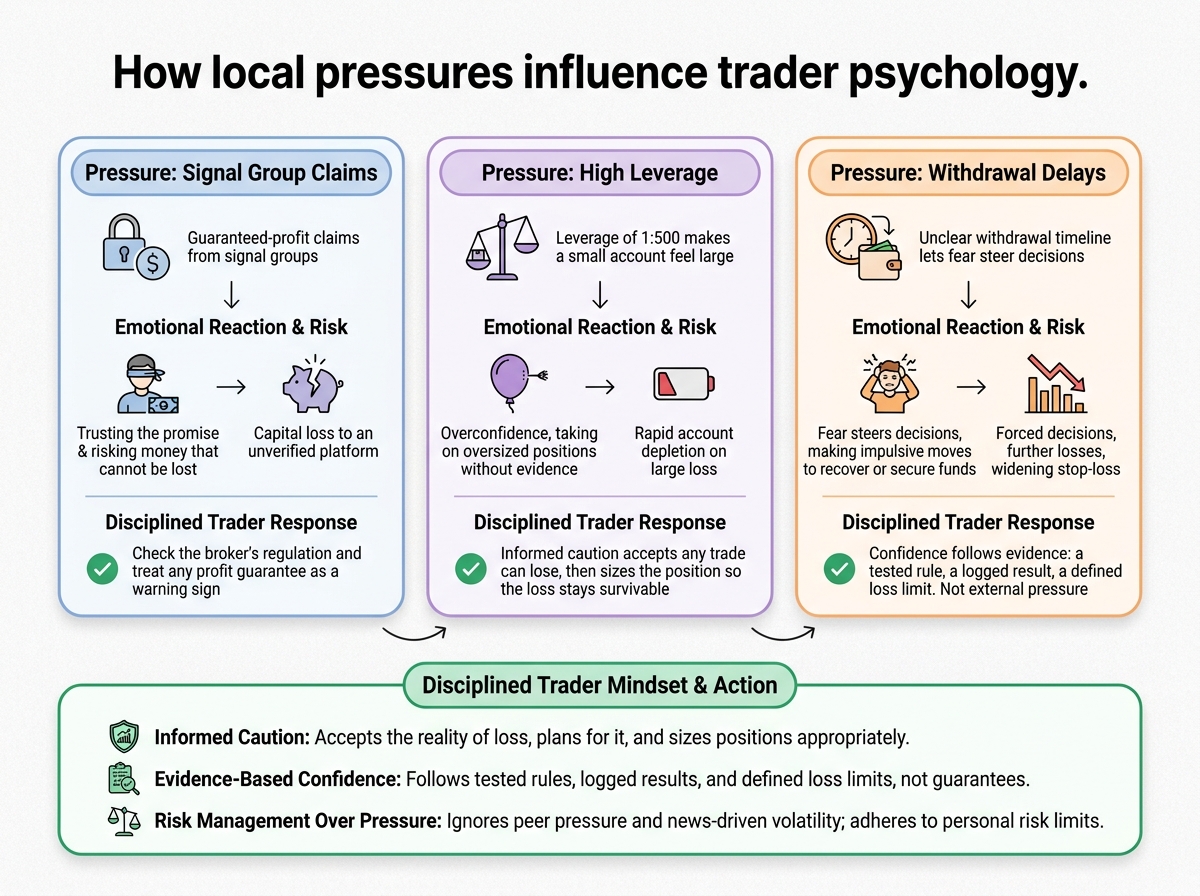
Local pressures sharpen this. Many traders in Dhaka, Chattogram, and Sylhet may enter ফরেক্স ট্রেডিং with an income expectation attached — a target that they feel they need to hit this month. Signal groups promise certainty, leverage of 1:500 makes a small account feel large, and an unclear withdrawal timeline lets fear steer decisions.
Confidence, overconfidence, and informed caution differ in what they respect. Confidence follows evidence; a tested rule, a logged result, a defined loss limit. Overconfidence skips evidence. Informed caution accepts that any single trade can lose, then sizes the position so the loss stays survivable.
Most pressures demand faster decisions than a plan can handle. Writing responses in advance removes the speed advantage that emotion depends on. Emotion does not need to be eliminated; it needs rules that hold when it arrives. By understanding these dynamics, traders can better navigate the emotional minefield that impacts execution.
How trading psychology affects each decision
Psychology plays a role at four critical points in every trade, and each point requires a different focus.
Before entry, the plan decides risk.
During exposure, patience gets tested.
After exit, the result invites you to rewrite the story.
Before entry, the work is arithmetic.
According to recent research, you fix a risk limit — commonly 1% to 2% of capital — and name the price that proves the idea wrong.
That invalidation point turns an opinion into something testable.
Once the position is live, fear, greed, hesitation and the urge to interfere arrive together.
Fear closes winners early.
Greed adds size after a good run.
Hesitation skips the setup you planned for.
The urge to interfere is quietest of the four, and it looks like a hand drifting toward the stop-loss.
Leverage amplifies the emotional volume along with the position.
At 1:100, a 1% move in the pair swings a large share of your margin, so an ordinary fluctuation feels like an emergency.
Spreads widen during news releases and slippage fills you at worse prices, which turns routine trades into stressful ones.
After a win, overconfidence whispers that the next position deserves more size.
After a loss, revenge insists the market owes you a recovery.
Both responses break the same rule, and both leave a trace in the record.
A trading journal is what converts those feelings into reviewable evidence.
Note the emotion before entry, while holding, and after exit, then look for the pattern across twenty trades.
Three revenge entries in a month is not a mood — it is a measurable leak with a fix.
The market only charges you for decisions you actually make.
Reviewing them honestly
Examples, mistakes, and misconceptions
Two losses in a row is where most plans break.
Picture a trader in Chattogram who closes a USD/JPY position at a loss, watches the same setup reappear an hour later, and enters at triple the size to win it back.
The chart repeats.
The rule does not.
By the third entry, the loss is no longer the size the plan allowed.
Nothing in the market changed between those three trades — only the decision process did.
That is why we track entries and exits together, not just the final number.
A strong mindset doesn’t mean feeling no fear.
Fear shows up in every trader who risks real money, and trying to erase it usually backfires.
What changes is the response.
A person who feels nothing before a trade is often not calm — they are numb, or they have stopped noticing risk at all.
Misconception: more trades and higher leverage bring faster success. Leverage multiplies losses as quickly as gains, and it moves your margin call closer with every pip.
The trader chasing speed with 1:500 leverage is not trading more efficiently.
They are simply closer to being stopped out.
Misconception: an AI signal, a managed account, or a guaranteed return removes the need for judgment. Any platform promising fixed profits is describing something no verified broker can deliver, because returns are never guaranteed.
A signal tells you where.
It does not tell you whether the entry fits your risk, your capital, or your plan.
A honest সফলতার মন — a success mindset — is not confidence without doubt.
It is a set of rules you follow on the days you least want to.
Practical applications and limits
By this point in ফরেক্স 트েডিং, the useful question is no longer whether mindset matters, but where to apply it.
A routine makes that concrete: before each entry, the trader answers a fixed set of questions; after each exit, they answer a shorter one.
The point is repetition, not perfection—each checklist is a mechanism for turning “mental discipline” into a consistent decision process.
Think of it like a pre-flight and a post-flight review: you’re not trying to predict every gust of wind, you’re making sure you follow the same safety steps every time and then learning from what actually happened.
Practically, the pre-trade checkpoint anchors attention on what must be true for this trade to be taken, while the post-trade checkpoint closes the loop so the trader can detect patterns in thinking rather than just reacting to outcomes.
There are limits to this approach.
A checklist can’t eliminate uncertainty, and it can’t guarantee profits.
What it can do is reduce impulsive action and clarify whether the trade matched the trader’s own process.
A pre-trade and post-trade checkpoint list
| Checkpoint | Question to ask | Action if the answer is no |
|---|---|---|
| Entry readiness | “Does this match my planned conditions?” | Pause and reassess before placing the trade |
| Rationale check | “Can I state why I’m entering, clearly?” | Don’t enter; rewrite the reason or wait |
| Risk discipline | “Am I following my intended boundaries?” | Reduce exposure or skip the setup |
| Post-exit review | “Does my exit align with the process?” | Note what broke the routine and adjust next time |
ফরেক্স মার্কেটে প্রতিদিন কত টাকা লেনদেন হয়?
ফরেক্স মার্কেটে প্রতিদিন 6 ট্রিলিয়ন মার্কিন ডলার পর্যন্ত লেনদেন হয়, যা এটি বিশ্বের সবচেয়ে বড় আর্থিক বাজারে পরিণত করে। এই বিশাল পরিমাণের লেনদেনের ফলে ব্যবসায়ীরা টাকার অঙ্কে বড় লাভ অর্জনের সুযোগ পান।
কিভাবে ফরেক্স ট্রেডিং শিখব?
ফরেক্স ট্রেডিং শেখার জন্য প্রধানত একটি ভাল পরিকল্পনা এবং ডিসিপ্লিন থাকা প্রয়োজন। শুরুতে বিভিন্ন শিক্ষা উপকরণ, অনলাইন কোর্স এবং ডেমো অ্যাকাউন্ট ব্যবহার করে প্রাথমিক দক্ষতা অর্জন করুন এবং পরে বাস্তব পরিস্থিতিতে ট্রেডিং করতে শিখুন।
ট্রেডিং করে কি টাকা ইনকাম করা যায়?
হ্যাঁ, ফরেক্স ট্রেডিং করে টাকা ইনকাম করা সম্ভব, তবে এটি কঠোর পরিশ্রম এবং ভালো পরিকল্পনার প্রয়োজন। সফল ব্যবসায়ীরা তাদের কৌশল ও মনোভাবের উপর যথাযথ মনোযোগ দিয়ে নিয়মিত উপার্জন করতে পারেন।
Forex এর কাজ কি?
ফরেক্স হলো বৈদেশিক মুদ্রার বাজার, যেখানে বিভিন্ন দেশের মুদ্রাগুলি একে অপরের সাথে লেনদেন হয়। ব্যবসায়ীরা এই বাজারে মুদ্রার অঙ্গভঙ্গি এবং বিভিন্ন অর্থনৈতিক গতি বিষয়ে ধারণার ভিত্তিতে অবস্থান নেন।
What is the most successful strategy in forex trading?
The most successful strategy in forex trading is one that incorporates disciplined risk management, psychology, and a clear trading plan. It is not just the strategy itself, but the mindset of the trader that determines success in navigating market uncertainties.
Consistency Starts Before the Trade, Not During It
The trader in Dhaka who lowered his stop loss that afternoon had a strategy.
What he did not have was a rule strong enough to survive the moment fear arrived.
That gap — not chart knowledge — is where most forex trading accounts quietly fall apart.
Every technique covered here points back to the same idea: a plan only works if your mind agrees to follow it.
Position size, stop placement, and journaling are not separate skills from psychology.
They are psychology, written down in advance.
Start small today.
Before your next trade, write one sentence on why you are entering and one on what would prove you wrong.
If you cannot write both, skip the trade — that habit will do more for your consistency than any indicator.