
A trader in Dhaka sends 50,000 taka to a platform advertising blockchain-powered forex returns.
The dashboard shows green numbers within days.
The withdrawal button stays grey.
The gap between what a platform promises and what you can actually withdraw is where important talks about blockchain in trading should start.
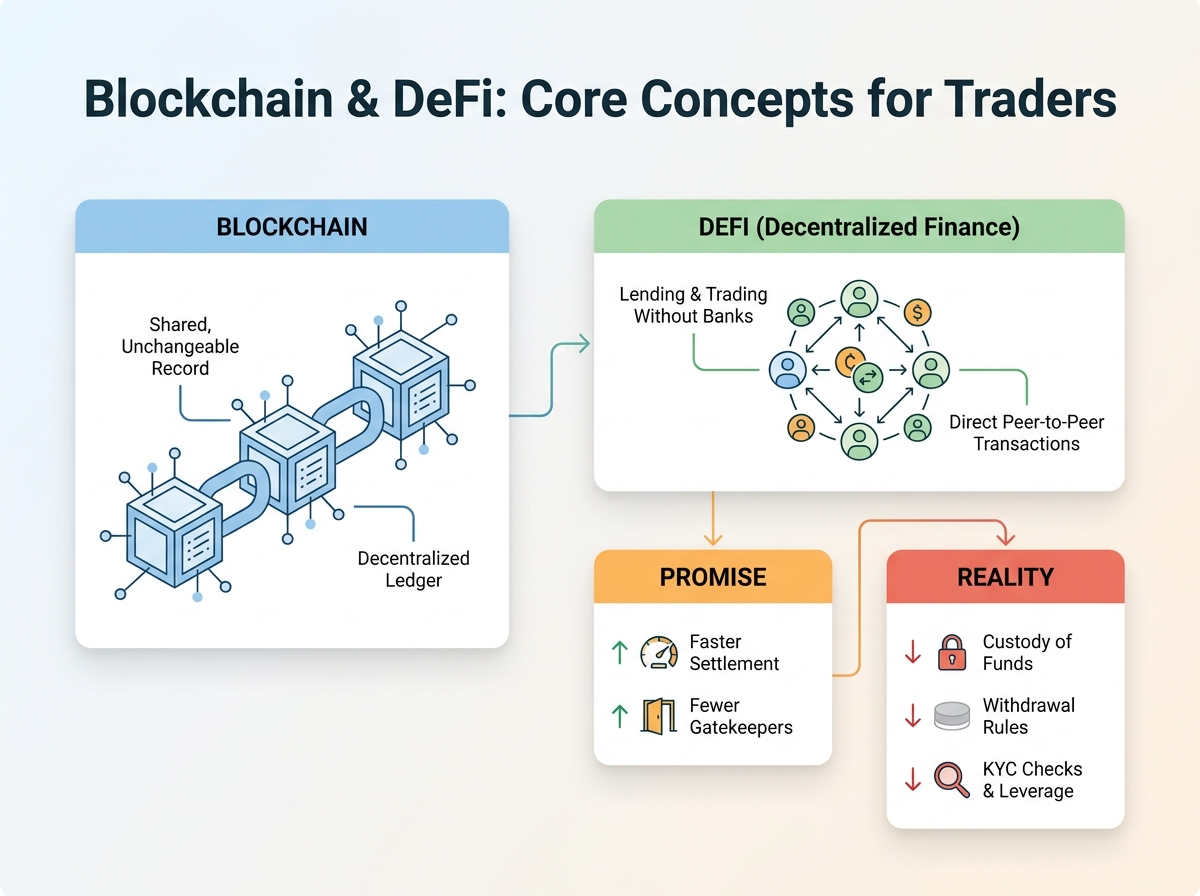
Blockchain is a shared record that thousands of computers keep at once, so no single party can quietly rewrite it. DeFi builds on that idea by letting people lend, borrow, and trade without a bank standing in the middle.
Traders in Dhaka, Chattogram, or Sylhet can easily see the appeal.
Settlement can be faster, there are fewer gatekeepers, and access is no longer tied to a local bank branch.
The trouble sits in the same old places: custody of your funds, withdrawal rules, KYC checks and leverage nobody capped.
None of that makes the technology useless.
You should understand it before you move money, not after.
Quick Answer: Blockchain and DeFi reshape forex trading by speeding up settlements and lessening your dependence on traditional banks. However, traders must navigate challenges like fund custody and stringent withdrawal rules to avoid pitfalls. Understanding these technologies is essential before engaging in transactions to mitigate risks effectively.
ব্লকচেইন কী? A plain-language definition for forex readers
A trader in Dhaka logs into a broker he has used for two years. He deposits BDT, opens a position on EUR/USD, and sees his balance update in seconds.
Later that night, a Facebook group tells him that research from www.weforum.org shows a ‘DeFi forex’ platform does the same thing ‘on the blockchain’—offering 40% monthly returns.
One story is familiar.
The other is a promise.
ব্লকচেইন is the part worth understanding properly: a shared record of transactions that thousands of independent computers keep, compare, and agree on.
No single office can change that record quietly since every other copy would stop matching.
It is neither a broker, a platform, nor a currency.
A broker is a company that holds your account and quotes your prices.
A trading platform is the software you use.
A cryptocurrency is an asset recorded on a blockchain.
Different layers come with different risks. Mixing them up can make misleading offers sound convincing.
DeFi ফরেক্স, in its honest form, means software—smart contracts—handling deposits, trades, and withdrawals without a company sitting in the middle.
True peer-to-peer currency settlement is still rare. Most services claiming to be peer-to-peer are just regular brokers with a crypto brand.
This technology can help record transfers clearly and let you check balances without needing anyone’s permission.
It cannot guarantee returns, make an unlicensed operator trustworthy, or remove risks from counterparties and withdrawals.
Rules covering crypto activity in Bangladesh have shifted more than once, so treat any availability claim as changeable rather than settled.
Learn the mechanism before you send anyone money: a shared record is a tool for verification, not a safety net.
Why blockchain matters to Bangladeshi forex traders
A trader in Chattogram, who has withdrawn from the same broker for three years, rarely asks where his money is.
The question usually shows up only when something breaks: a delayed payout, a frozen account, or a Facebook post promising instant settlement without a bank in the middle.
This is where blockchain becomes important.
The technology behind ব্লকচেইন offers three concrete things: faster settlement, a shared record that cannot be quietly edited, and access to markets that often wait on a bank’s approval queue.
If you’ve seen an international transfer take days, this promise is easy to get.
But “appeal” is not protection.
A public ledger can show that a transaction occurred, but it does not prove who is on the other side, whether they will allow a withdrawal, or if the platform is legal in Bangladesh.
Bangladesh has its own issues.
KYC checks, deposit channels, currency controls, and record-keeping obligations all shape what a trader can legitimately do—and these rules shift over time.
And while blockchain can improve how transactions are logged and settled, no verified source confirms that any DeFi-style forex service currently operates in Bangladesh.
How blockchain and DeFi can affect forex trading
Remove the marketing and the mechanism becomes easier to understand.
A DeFi-style forex product uses the same blockchain as other crypto transactions, but each step includes more chances for problems.
Start with ownership.
Instead of a physical deposit, the asset, currency, or claim exists as a digital entry.
What you really ‘hold’ is based on a token balance or a contract balance, so your exposure depends on how those records are created and changed.
Next, smart contracts automate whatever the developers coded: a payout rule, a liquidation trigger, and a fee split.
Think of them as a self-running rulebook. It does not pause to interpret intent. If the inputs don’t match the conditions, you get the programmed outcome.
Then you need the other side of the trade. Liquidity pools (or matched counterparties) supply the liquidity your trade consumes, and without them there is no fill.
Even when the contract is ready, execution depends on whether there is available capacity when you try to make the transaction.
Oracles feed external prices in, because a blockchain cannot see EUR/USD on its own.
Lastly, settlement completes the process by updating balances based on the contract’s rules, turning the agreed terms into recorded on-chain transfers.
Realistic examples and common misconceptions
Imagine a trader in Gazipur who already trades EUR/USD through a familiar broker.
An ad on Telegram says DeFi ফরেক্স settles ‘like the real market’ using blockchain. They compare it to their regular platform.
That comparison fails when it comes to tokenized exposure.
A “tokenized EUR/USD position” may track price through a protocol, but the trader doesn’t truly own the underlying FX exposure in the same way a regulated broker provides it.
The gap shows up when there is less liquidity or when the rules for redeeming tokens change.
Transparency can also feel like proof.
Even if transaction history is public, it only confirms data moved on a chain.
It doesn’t show who controls the withdrawal process, manages the user interface, or if the ‘broker’ address is tied to a real, responsible entity.
The same caution applies to the high-yield pitch.
High returns in a DeFi-style forex offer often come from leverage, weak liquidity, or protocol-level risks, not magic.
If the protocol needs constant funds to honor withdrawals, yield can drop exactly when traders want to withdraw cash.
A common misconception is that ব্লকচেইন removes brokers, spreads, leverage, and counterparty risk; it usually just changes the paperwork and can introduce new ones like contract risk.
Another misconception is that smart contract terms guarantee profit or protect all withdrawals. Code can fail, keys can be mismanaged, and withdrawals can be paused.
Even a clean wallet, an “audited” badge, or a professional site can mislead, describing code quality or branding without guaranteeing custody, pricing integrity, or enforcement.
Scams often use newer technology to seem safer than they really are. Treat every promise as a question of risk, not trust.
Practical decisions, limits, and a safer evaluation framework
A Bangladesh trader comparing a familiar broker with a DeFi ফরекс “platform” usually focuses on speed.
Safety comes later and depends on where funds are, how payouts work, and who can freeze or reverse actions.
View newer technology as a change in process, not a lowered risk. 블কচেইন records may seem trustworthy, but custody and withdrawals can still be weak.
Before making a deposit, ask clear questions about custody, liquidity, and the source of price information.
If tokenized positions rely on oracle data, confirm oracle design, what happens during price outages, and whether multiple feeds exist or just one.
Check leverage limits too—some designs advertise low risk while contract terms allow high effective exposure.
Then watch the withdrawal path as closely as trade entry: guaranteed returns, urgency tactics, referral rewards tied to reinvestment, and anonymous operators are common scam signals, and “success” that stops at withdrawals is especially suspicious when customer support can’t explain on-chain or off-chain transfer steps.
| Check | What to verify | Warning sign | Decision |
|---|---|---|---|
| Operator identity | Legal entity name, address, leadership | Anonymous team, unverifiable details | Pause and document |
| Regulatory status & availability | Legal offering + how terms handle Bangladesh | “Works anywhere” marketing | Demand written terms |
| Custody model | Where assets are held | Vague custody wording | Do not deposit |
| Liquidity source | Funding + stress exits | “Always available” claims | Run a withdrawal test only |
| Fees and slippage | Exit fees, spread handling | Fees hidden in promotions | Model total cost |
| Leverage terms | Max leverage, liquidation, margin method | Leverage not explicitly defined | Use minimal size |
| Oracle design | Providers, fallback, update frequency | Single feed, no outage plan | Skip until clarified |
| Smart-contract audit limits | Current + what is out of scope | “Audited” with no scope details | Treat as untrusted |
| Withdrawal process | Steps, timing, networks | “Withdraw later” loops | Trial only, keep receipts |
| Customer support & dispute route | Dispute handling if transfers fail | No clear dispute path | Avoid participation |
Verify, test with the smallest exposure, and keep records of every instruction, fee, and withdrawal attempt so “new tech” becomes a controlled experiment, not a leap of faith.
What are the benefits of blockchain in forex trading?
Blockchain offers faster settlements, enhanced transparency, and a tamper-proof record of transactions in forex trading. This technology reduces reliance on traditional banks, allowing for quicker access to market opportunities.
How does DeFi impact traditional forex trading methods?
DeFi allows traders to lend, borrow, and trade without intermediaries, altering the conventional forex trading landscape. While it promises greater accessibility and quicker settlements, it introduces complexities regarding fund custody and tokenized positions.
What risks do traders face with blockchain and DeFi in forex?
Traders face risks such as inadequate custody of funds, complex withdrawal processes, and potential liquidity issues. These factors can lead to discrepancies between promised returns and actual accessibility of investments.
Why is custody important in DeFi forex platforms?
Custody is crucial in DeFi forex platforms because it determines how securely and readily traders can access their funds. Without a solid custody structure, traders may experience delays in withdrawals or potentially lose control over their assets.
How can traders evaluate the safety of DeFi forex products?
Traders should assess the custody arrangements, liquidity levels, and the reliability of pricing sources for DeFi forex products. Asking direct questions about these aspects can help clarify the potential risks involved before making a deposit.
What a Grey Withdrawal Button Really Tells You
The technology was never the actual risk.
Blockchain can genuinely make settlement faster and records harder to tamper with, but none of that matters if the platform holds your funds and decides when you can take them out.
Think of that Dhaka trader with green numbers and a grey withdrawal button.
Nothing on-chain failed him; his access to his own money did.
Custody, withdrawal terms, and licensing outrank any headline about decentralised trading or new technology.
Before your next deposit, do this today: ask for a small withdrawal first.
If it processes quickly and the terms are clear, you have real proof.
Our broker reviews examine custody rules and withdrawal reliability for Bangladeshi traders. This is often where that check begins.