
A bad trade rarely empties an account.
The five minutes after it often do.
Talk to any trader in Dhaka, Chattogram, or Sylhet who has watched a funded account disappear, and the story follows a familiar arc.
One entry goes wrong, the stop-loss starts to feel negotiable, and the lot size doubles to win it all back.
No strategy survives that moment.
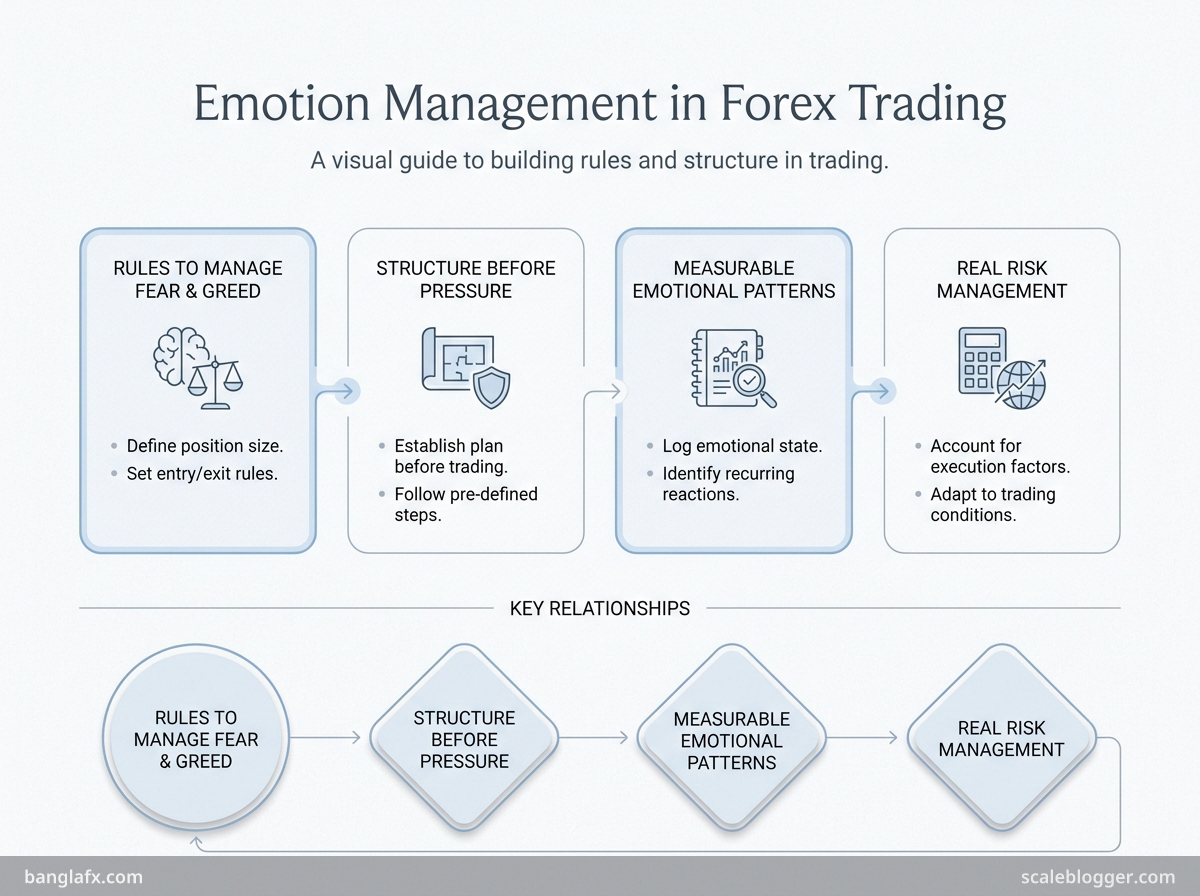
Emotion management is the practice of building rules that keep fear and greed away from your position size, your entry timing, and your exits.
It has far less to do with staying calm than with having structure in place before the pressure arrives.
It is also measurable.
Traders who log their emotional state beside each trade begin to notice patterns.
Revenge entries after a loss.
Hesitation after two wins.
Oversized positions on a quiet Friday afternoon.
Real risk management in Bangladesh has to account for mobile execution, limited screen time, and the isolation of trading without a mentor.
Quick Answer: Effective emotion management in forex trading starts with clear rules for position sizing, stop-loss placement, and trade exits that keep fear and greed from skewing your choices. If you log your emotional state alongside each trade, you’ll spot damaging habits like revenge trading or over-leveraging, which helps maintain your discipline. Setting fixed stop-loss orders before entry, especially when markets get volatile, is key to controlling risk and protecting your capital.
What Emotion Management Means in Forex Trading
Emotion management in forex is the practice of keeping your feelings out of your position size, your stop-loss, and your broker choices.
It is a control system, not a personality trait.
Traders who manage emotions well still feel fear and excitement—they just stop those feelings from making trading decisions for them.
Managing and removing emotion are different.
Removing emotion is impossible; markets run on collective fear and greed, so a trader with zero feeling would have no useful read on the market at all.
Managing emotion means building rules that hold steady whether you are calm or rattled.
A stop-loss set before entry, for example, does not react to how you feel at 2 a.m.
Dhaka time when the position moves against you.
The emotions that most often damage decisions are familiar ones: fear, greed, regret, and the stubborn hope that a losing trade will turn around.
Fear pushes traders to close winners too early.
Greed encourages over-leveraging on a signal that looks certain.
Regret after a missed move can fuel revenge trading—a rapid series of impulsive entries meant to win back what was lost.
Hope is quieter but costly.
It keeps a trader holding a losing position well past the level where the plan said to exit, sometimes while a withdrawal request sits blocked and unanswered.
This guide treats emotion management as an operational risk system, not a motivational speech.
It focuses on trading behaviour, position sizing, execution conditions, broker due diligence, and record-keeping—the practical controls that make emotional decisions harder to carry out and easier to spot afterward.
Risk controls reduce exposure; they never guarantee profit or make an unverified broker safe.
Read the next section as a toolkit, not a set of affirmations.
The controls only work when they are written down before the market opens.
Why Emotion Management Matters When You Trade Forex From Bangladesh
A stop-loss looks solid until a losing trade starts to sting.
That’s the moment fear stops thinking and starts clicking.
Fear and greed rarely announce themselves.
They show up as a widened stop, an extra lot added to a losing position, or a winner closed early for a small “safe” profit.
Each choice turns a planned, manageable loss into a larger risk you never agreed to take.
Leverage amplifies the feeling as much as the position.
A 1:500 account can swing hard on a single news candle, and spread widening plus slippage means your expected fill is rarely your actual one.
That gap between plan and reality is where panic decisions live.
In Bangladesh, a second layer sits underneath the trading itself. Broker verification, withdrawal timelines, KYC document requests, and the steady stream of “guaranteed profit” pitches on social platforms all create pressure before a single order is placed.
When cashing out already feels uncertain, traders hold losing positions longer than they should — hoping to fix the first problem before confronting the second.
Written records cut through all of it.
Log your entry, exit, reason, position size, and mood at the time.
Over a few weeks, patterns surface: which setups you abandon, which hours you overtrade, and how often a withdrawal worry quietly changed your plan.
That same log becomes the paper trail you will want if trading income or ROI ever needs to be accounted for.
Calm traders are not fearless.
They have simply decided in advance what happens next, and written it down.
How Emotion Management Works During a Trading Decision
Emotion rarely shows up as a feeling you can name.
It shows up as a click—a stop dragged wider, a lot size typed in a hurry, a position opened into a news spike.
The mechanism is a loop: a market event triggers a physical reaction, the reaction produces an interpretation, and the interpretation produces a trade.
Break any link and the outcome changes.
A written plan breaks the loop before it starts.
Set your entry, exit, lot size, and maximum daily loss the night before, in numbers on paper, so the decision no longer belongs to the moment when your judgment is most expensive.
Risk limits work the same way: if your maximum risk per trade is fixed at a small percentage of account equity before the session opens, a losing streak cannot quietly renegotiate it during a volatile release.
Pause-and-check sits between impulse and execution—sixty seconds and three questions (does this match my plan, has my risk changed, am I reacting to price or to a headline) are usually long enough for the urge to fade.
The journal then closes the loop by turning “I panicked” into a record you can fix.
Pre-Trade and In-Trade Risk Controls by Emotional Trigger
| Emotional trigger | Typical trading mistake | Preventive rule | Action when the trigger appears |
|---|---|---|---|
| Fear after a losing trade | Increasing lot size to recover the loss quickly | Cap daily loss at a fixed percentage and stop for the day | Close the platform, log the trade, return next session |
| Greed after a winning streak | Removing the stop-loss to let a winner run | Keep the stop at the pre-planned level; move it only toward profit | Withdraw part of the gain and reset position size to base |
| Urgency during breaking news | Entering mid-spike with wide spreads and slippage | No new entries for 15 minutes after a major release | Wait for the spread to normalise before reviewing the chart |
| Anger after a stopped-out position | Re-entering immediately in the opposite direction | One re-entry maximum per setup, logged in advance | Step away for 30 minutes and review the setup on a fresh chart |
| Distrust caused by withdrawal delays | Moving funds to an unverified broker to “test” them | Verify regulation and payout terms before depositing | Pause new deposits and document the delay in writing |
Each rule limits exposure; none of them prevents a loss or makes an unverified broker safe to use.
What makes it work is the pairing: every trigger already has an answer written down, so the decision is retrieval rather than invention—and retrieval is something a stressed brain can still do.
Practical Examples and Common Misconceptions
Revenge trading rarely feels like revenge.
It feels like recovery—you double the lot on the next setup, certain the market owes you that loss back.
The control is mechanical: after any loss, a mandatory thirty-minute cooldown with the platform closed, recorded in the same log where the loss was written.
Widening spreads around major news create a different kind of pressure.
Slippage can turn a planned 20-pip stop into a 40-pip exit, and fear pushes you to close everything at the worst available price.
Pre-news rules—halve the position size or stand aside entirely—remove that decision from the moment it matters most.
The guaranteed-profit pitch usually arrives by message, promising fixed monthly returns on a “managed account.”
Legitimate broker communication never promises returns or asks you to bypass KYC.
It states risk plainly, explains withdrawal terms, and lets you check the licence through the regulator directly.
Three misconceptions keep reappearing, and each one costs money.
Confidence is not a licence for larger positions; conviction changes nothing about leverage.
A stop-loss does not rescue a strategy with no real edge, because it limits the damage rather than improving the odds.
And emotional discipline cannot make an unverified broker safe—executing calmly means nothing if the withdrawal never arrives.
Each control follows the same chain: spot the trigger, apply the rule you wrote yesterday, keep the loss small and the record honest.
That chain separates a bad week from a blown account.
Key takeaways:
- Revenge trading: A mandatory cooldown after every loss prevents the single most damaging click.
- News volatility: Pre-news position-sizing rules remove the decision from the moment of slippage.
- Scam signals: Guaranteed returns, pressure to deposit, and KYC shortcuts are disqualifying, every time.
- Honest limits: Confidence, stop-losses, and calm execution reduce exposure—none of them replace a verified broker or a real edge.
Applying Emotion Management to Safer Trading Decisions
Discipline breaks fastest when you’re tired and the market is loud.
A daily routine fixed to Dhaka time keeps decisions away from that moment.
Build the day in blocks.
Before the London open—around 1:00 pm BST—write the plan: pairs, lot size, stop level, and the releases you will avoid.
Trade only inside the window you named, then close the platform at a fixed hour and log the result.
The routine works because it removes timing decisions from a tired brain.
Some days you should not trade at all.
A poor night’s sleep, family or work stress, and the thirty minutes either side of a high-impact release such as US CPI or NFP sharpen the urge to click.
Skip those windows, and skip any broker that has not yet shown you a clean withdrawal.
Broker suitability is a paperwork question, not an urgency question.
Verify licensing and segregation claims, test a small deposit and withdrawal, and read the KYC terms before the market gives you a reason to rush.
Where emotional rules meet the operational controls
| Decision area | Emotional risk | Practical control | Warning sign that requires a pause |
|---|---|---|---|
| Position size | Adding lots to recover a loss | Fixed percentage per trade, written before entry | You are calculating size after the entry |
| Leverage | Feeling “safe” because the margin is free | Capped account leverage you can survive a gap with | You cannot state your stop in pips |
| Entry and exit rules | Moving the stop to avoid being wrong | Stop and target set at order placement | You moved a stop twice this week |
| Deposit and withdrawal | Depositing more to “average out” | Small test withdrawal before scaling capital | Withdrawal is delayed or the terms changed |
| Records and review | Judging yourself by one trade | Weekly log review against the written plan | You cannot explain last week’s results |
None of them makes an unverified broker safe, and none guarantees profit.
Test it for thirty days on demo or very small size, scoring each day on whether you followed the plan rather than on profit.
If you break the rules three days running, stop trading for the week.
What is the best trading strategy in 2026?
The best trading strategy in 2026 emphasizes effective emotion management, including setting fixed stop-loss orders before entry, establishing strict position sizing rules, and maintaining a written trading plan. This approach prevents fear and greed from influencing decisions and enhances discipline, especially during volatile market periods.
Is forex trading still profitable in 2026?
Forex trading remains potentially profitable in 2026 when traders apply strict emotion management techniques such as disciplined stop-loss placement, fixed position sizing, cooldown periods after losses, and adherence to a trading routine that avoids decision-making under stress or fatigue.
What is the 3-5-7 rule in trading?
The article does not mention a 3-5-7 rule in trading, so there is no specific explanation or definition provided for this rule in the context of forex trading or emotion management.
What is the most successful strategy in forex trading?
The most successful forex trading strategy involves emotion management where traders follow strict rules on position sizing, stop-loss placement, exit timing, and maintain a trading log to detect emotional patterns. Consistently applying these rules prevents impulsive decisions driven by fear or greed.
What percent of retail traders lose money?
The article does not provide a specific percentage of retail traders who lose money, but it highlights that many traders face losses due to poor emotion management, overly large positions, and deviation from their trading plans, implying a significant portion struggle to maintain profitability.
Traders who last long enough to compound gains rarely have the sharpest charts.
They treat emotion management as part of their risk system: a position size they refuse to break, a cooling-off rule after every loss, a written record of why they entered.
Consider the trader who doubled his lot size minutes after a stop-out, chasing what the market owed him.
That decision, not the original loss, emptied the account.
Emotional control sits between a bad day and a blown balance.
Write your trade plan before you open the platform, and make it a hard rule: no position size changes for one hour after any loss.
Our risk management and emotion control guides are built on that discipline.